Thank you for your collaboration in the Wrist Algorithm Verification and Evaluation Study (WAVES). This repository contains all the code needed to run multiple wrist algorithms against your raw data.
Proposed Flow Diagram
The proposed flow diagram outlines the process for how the validation data and data pipeline will work with the WAVES team and groups who have potentially available validation data.
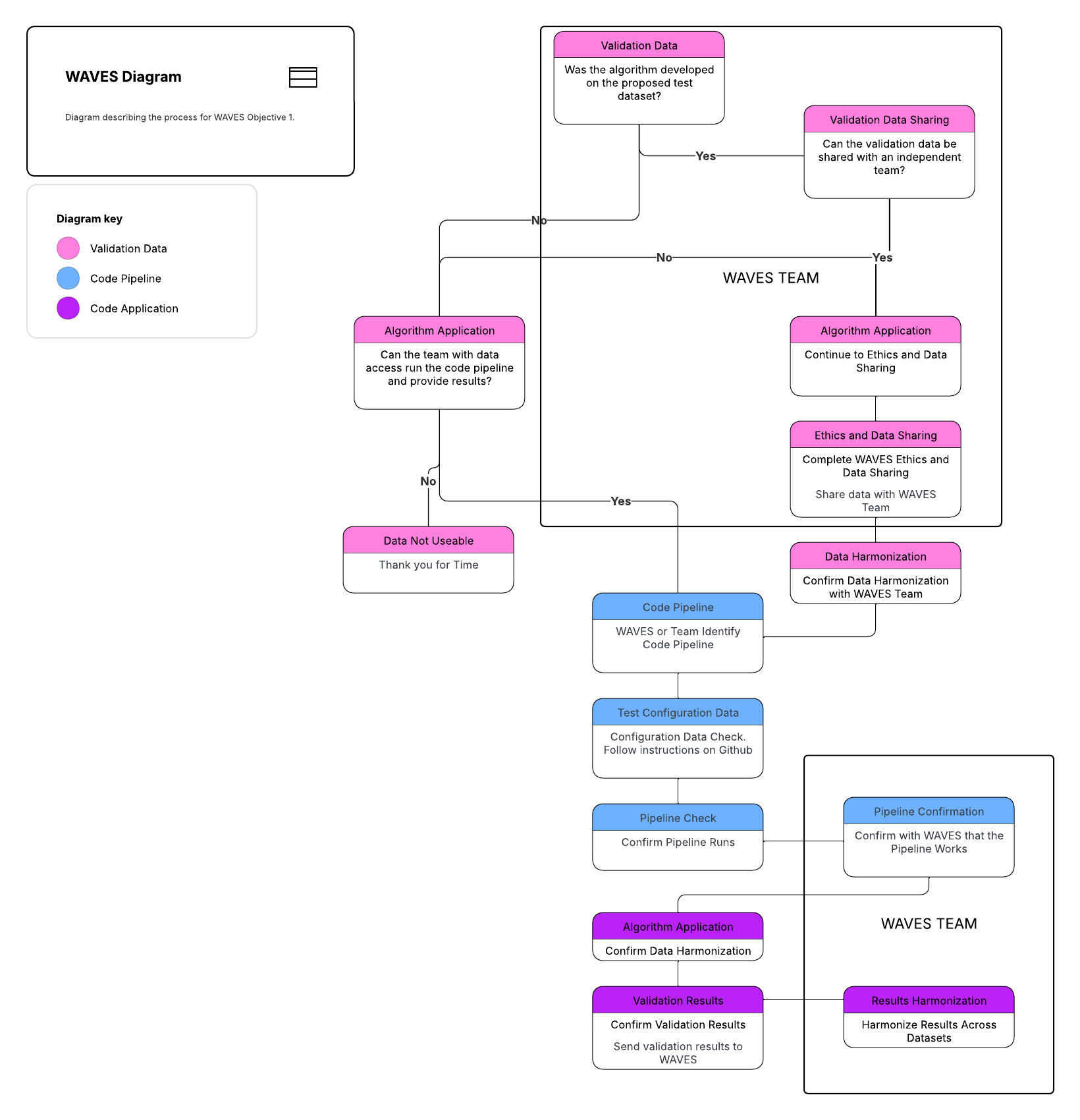
Full description of the flow diagram coming soon
Getting Started
Visit the Github Pages for WAVES and click on the “Get Started” tab.
FIGURE showing the “Get Started” page
Methods Implemented
| Method | MVPA | SED | Steps |
|---|---|---|---|
| Bakrania 20161 | ❌ | ✔️ | ❌ |
| Ellis 20162 Extended | ✔️️ | ✔️ | ❌ |
| Esliger 20113 | ✔️ | ✔️ | ❌ |
| Fraysse 20204 | ✔️ | ✔️ | ❌ |
| Hildebrand 20145/20176 | ✔️ | ✔️ | ❌ |
| Mielke 20237 | ✔️ | ✔️ | ❌ |
| Montoye 20188 | ✔️ | ✔️ | ❌ |
| Trost 20179 Extended | ✔️ | ✔️ | ❌ |
| Walmsley 202210 (accelerometer v7.3.011) | ✔️ | ✔️ | ❌ |
| White 201612 ENMO and HPFVM | ✔️ | ✔️ | ❌ |
| Yuan 202413 (actinet) | ✔️ | ✔️ | ❌ |
| Oak14 | ❌ | ❌ | ✔️ |
| Small 202415 (stepcount v3.17.116) | ❌ | ❌ | ✔️ |
| Step Detection Threshold17 (SDT) | ❌ | ❌ | ✔️ |
| Verisense (Original)18 | ❌ | ❌ | ✔️ |
| Verisense (Revised)19 | ❌ | ❌ | ✔️ |
References for Methods
1.
Bakrania K, Yates T, Rowlands AV, et al. Intensity thresholds on raw acceleration data: Euclidean norm minus one (ENMO) and mean amplitude deviation (MAD) approaches. PLOS ONE 2016; 11: e0164045.
2.
Ellis K, Kerr J, Godbole S, et al. Hip and wrist accelerometer algorithms for free-living behavior classification. Medicine & Science in Sports & Exercise 2016; 48: 933–940.
3.
Esliger DW, Rowlands AV, Hurst TL, et al. Validation of the GENEA accelerometer. Medicine & Science in Sports & Exercise 2011; 43: 1085.
4.
Fraysse F, Post D, Eston R, et al. Physical activity intensity cut-points for wrist-worn GENEActiv in older adults. Frontiers in Sports and Active Living; 2. Epub ahead of print 15 January 2021. DOI: 10.3389/fspor.2020.579278.
5.
Hildebrand M, Van Hees VT, Hansen BH, et al. Age group comparability of raw accelerometer output from wrist- and hip-worn monitors. Medicine & Science in Sports & Exercise 2014; 46: 1816.
6.
Hildebrand M, Hansen BH, Hees VT van, et al. Evaluation of raw acceleration sedentary thresholds in children and adults. Scandinavian Journal of Medicine & Science in Sports 2017; 27: 1814–1823.
7.
Mielke GI, Almeida Mendes M de, Ekelund U, et al. Absolute intensity thresholds for tri-axial wrist and waist accelerometer-measured movement behaviors in adults. Scandinavian Journal of Medicine & Science in Sports 2023; 33: 1752–1764.
8.
Montoye AHK, Westgate BS, Fonley MR, et al. Cross-validation and out-of-sample testing of physical activity intensity predictions with a wrist-worn accelerometer. Journal of Applied Physiology (Bethesda, Md: 1985) 2018; 124: 1284–1293.
9.
Pavey TG, Gilson ND, Gomersall SR, et al. Field evaluation of a random forest activity classifier for wrist-worn accelerometer data. Journal of Science and Medicine in Sport 2017; 20: 75–80.
10.
Walmsley R, Chan S, Smith-Byrne K, et al. Reallocation of time between device-measured movement behaviours and risk of incident cardiovascular disease. Epub ahead of print 1 September 2022. DOI: 10.1136/bjsports-2021-104050.
11.
Doherty A, Chan S, Yuan H, et al. Accelerometer: A python toolkit for extracting physical activity and behavior metrics from wearable sensor data. Zenodo. Epub ahead of print 13 July 2025. DOI: 10.5281/zenodo.15874476.
12.
White T, Westgate K, Wareham NJ, et al. Estimation of physical activity energy expenditure during free-living from wrist accelerometry in UK adults. PLOS ONE 2016; 11: e0167472.
13.
Yuan H, Chan S, Creagh AP, et al. Self-supervised learning for human activity recognition using 700,000 person-days of wearable data. npj Digital Medicine 2024; 7: 91.
14.
Straczkiewicz M, Huang EJ, Onnela J-P. A “one-size-fits-most” walking recognition method for smartphones, smartwatches, and wearable accelerometers. npj Digital Medicine 2023; 6: 29.
15.
Small SR, Chan S, Walmsley R, et al. Self-supervised machine learning to characterize step counts from wrist-worn accelerometers in the UK biobank. Medicine & Science in Sports & Exercise 2024; 56: 1945.
16.
Chan S, Small SR, Acquah A, et al. Improved step counting via foundation models for wrist-worn accelerometers. Zenodo. Epub ahead of print 15 January 2026. DOI: 10.5281/zenodo.18255030.
17.
Ducharme SW, Lim J, Busa MA, et al. A transparent method for step detection using an acceleration threshold. Epub ahead of print 25 October 2021. DOI: 10.1123/jmpb.2021-0011.
18.
Gu F, Khoshelham K, Shang J, et al. Robust and accurate smartphone-based step counting for indoor localization. IEEE Sensors Journal 2017; 17: 3453–3460.
19.
Maylor BD, Edwardson CL, Dempsey PC, et al. Stepping towards more intuitive physical activity metrics with wrist-worn accelerometry: Validity of an open-source step-count algorithm. Sensors; 22. Epub ahead of print 18 December 2022. DOI: 10.3390/s22249984.